The Power of Smells

This interview was really fun and interesting.

The sense of smell is the sense most tied to emotion and memory.
What memory or emotion do these smells evoke for you?

Freshly baked bread
Roses
Popcorn
Bacon
Campfire
Pinecones
Coffee
Gasoline
Horse Manure

On the Matt Townsend Show (BYU Radio) we discuss how smells literally change behavior. Depending on the ambient smells, we can influence employee behavior, public behavior, or behavior in our children to be kinder, more fair and ethical, more charitable, less deviant, and harder working.

Here is the link to the program.

https://www.byuradio.org/episode/c7c6b830-9a4f-45fb-a47b-2db8f35dd5f5/the-matt-townsend-show-the-making-of-donald-trump-how-to-get-stuff-done-power-of-smells?playhead=6786&autoplay=true

World’s Awaiting radio interview

I was interviewed for over an hour on BYU radio’s new program called “World’s Awaiting” about Children’s Books, Reading, and cultivating a Culture of Literacy in our Families. It will be airing this Saturday, September 10 at 11:30am Mountain / 1:30pm Eastern. You can hear it on BYU Radio at SiriusXM Channel 143, on the tunein app, and at http://www.byuradio.org.

You can listen to the audio of the interview on our website at 12:00 noon MST / 2:00pm EST after the show airs at http://www.byuradio.org/show/afc8b335-4272-4bf4-a192-9f850d0fe390/worlds-awaiting.

Bringing the Arts Home

I contributed to the Matt Townsend show on BYU radio about how the arts enrich home life. I give research about how the arts make your child smarts and practical ideas for creativity in the home.

https://www.byuradio.org/episode/99ef58c5-9885-446c-9521-3f52ab57fad5/the-matt-townsend-show-political-social-media-why-diets-make-us-fat-art-and-kids?playhead=6346&autoplay=true

School Success: BYU radio interview

School started today. *Sigh* It’s a bittersweet time.

Bitter:
No more relaxed, sunny days by the pool.
No more PBJ picnics.
No more late night star gazing and movie watching.
No more spontaneous UNO card games.
No more vacation from homework, alarm clocks, carpooling, and science fair projects.
No more shorts, T-shirts, flipflops and bedhead worn every day.

Sweet:
Adult alone time!
One word: schedules!
Mushy brains turn into learning brains again.
Not hearing “Mom. Mom. Mom. Mom” 868 times a day.
As my neighbor sang in a lilted, Christmas-y tone yesterday: “It’s the most wonderful time of the year.”

But the transition from summer to school can seem abrupt at best and often very difficult. It’s like living on planet Earth all summer and then being shipped to Mars. How can we help kids adjust easier and outfit them to thrive in that harsh climate? Here’s the BYU radio program I was interviewed for about preparing kids for school success.
https://www.byuradio.org/episode/bef82490-c5ad-4fa2-8453-0340424735f6/the-matt-townsend-show-public-space-crisis-smartphones-and-adhd-back-to-school?playhead=6518&autoplay=true

Father’s Day Trivia

How are your facts about fathers? Here are 20 trivia questions about fathers to celebrate with the special men in your life on Father’s Day.(Try not to peek at the answers at the end until you have tried them all). It would be a good game to play on Father’s Day to honor men who nurture, provide, and love children.

When you are done, consider asking more questions, but personal ones to your dads to learn more about them, their likes/dislikes, fears, funnies, history, favorite memories, and dreams for the future.

Questions:

1. Who do the “Founding Fathers” of our country refer to?

2. Who is known as the current “Holy Father” according to the Roman Catholic Church?

3. Roses are the official flower for Father’s Day. A red rose is worn in the lapel if your father is living, and this color rose if he is deceased.

4. Who is known to have initiated the Father’s Day celebrations, or who is called “The Mother of Father’s Day”?

5. In the USA, Father’s Day is celebrated on this day.

6. Who is the “Father” of our country?

7. Father’s Day the fourth-largest card-sending occasion with this many cards given out last year.

a. 80 million

b. 60 million

c. 95 million

d. 150 million

8. “Father Time” is also known by this name.

9. In Greek Mythology, this King of Thebes killed his father and married his mother. His name has become synonymous for this hidden desire to do the same to one’s parents.

10. The myth of “Father Christmas” has been taken from this country.

a. Denmark

b. Sweden

c. The Netherlands

d. Germany

11. Name the top 5 gifts for Father’s Day (besides a card).

12. This 1950’s TV show about fatherhood starred actor Robert Young.

a. “Father Knows Best”

b. “Father Does Best”

c. “Father Loves Best”

d. “Father Laughs Best”

13. Which actor voiced the famous movie line, “Luke, I am your father”?

14. According to Greek mythology, who was the father of gods and mortals?

15. Who was the famous literary father of the young girl nicknamed “Scout”?

16. Who was the father of Disney’s Arial, the Little Mermaid?

17. Which President signed into law that Father’s Day would be nationally recognized?

a. Woodrow Wilson

b. Richard Nixon

c. Theodore Roosevelt

d. John F. Kennedy

18. What is the word for “father” in these languages?

Afrikaans

Arabic

French

Hungarian

Italian

Polish

Spanish

Welsh

19. This 1991 movie called “Father of the Bride” starred this comedian.

20. What famous evangelist said this: “A good father is one of the most unsung, upraised, unnoticed, and yet one of the most valuable assets in our society.”

Answers:

1. Those at the 1776 Philadelphia convention who signed the Declaration of Independence.

2. Pope Francis

3. White

4. Sonara Smart Dodd, daughter of a Civil War veteran, who wanted to honor her father.

5. The Third Sunday of June

6. George Washington

7. c. 95 million

8. The Grim Reaper

9. Oedipus Complex

10. c. The Netherlands

11. Necktie/clothing, tools, sporting goods, electronics, candy

12. a. “Father Knows Best”

13. James Earl Jones

14. Zeus

15. Atticus Finch

16. King Triton

17. b. Richard Nixon

18. Afrikaans : vader

Arabic : babba

French : papa

Hungarian : apa

Italian : babbo

Polish : tata

Spanish : papá

Welsh : tad

19. Steve Martin

20. Billy Graham

Back to Basics

Being raised with a small farm and a big work ethic, I have always appreciated how a back-to-basics approach to parenting is the answer to what ills many families today.

Simplifying our over-complicated, over-stimulated lives is what children need.

They need to count the stars, find shapes in clouds, run their hands through shifting mud, make shapes in the sand, listen to birds calling their young, and count their footsteps through pastures and fields.

Children with very little are rarely poor; it is those with too much who are creatively poor, who lack imagination and are short on grit.

Watch this insightful video that beautifully contrasts “The Poorness in our Wealth.”

Behind every great kid is a pushy parent

Here’s a link to a revised version of this article that was published by ksl.com

When I was young, my mom required that all 5 children learn to swim until they could pass the Jr. Lifesaving class. I hated it. I hated water and the smell of chlorine. I hated diving for those weighted rings.

I looked up at my mother sitting in the spectator balcony and glared at her whenever I could. My body language clearly stated, “I can’t believe you are making me do this. You are the meanest mom in the world.” She just smiled back and waved at me.

About the time I was enrolled in the Jr. Lifesaving class, the movie “Jaws” came out. By today’s movie-making standards, the special effects are cheesy, but to my 11-year-old, fearful-of-anything aquatic, impressionable brain, it was horrifying. I couldn’t put my head under water (let alone take a bath) after seeing the film. When the swim instructors lined us up behind the diving board and it was my turn to arch over the horizontal bamboo stick to dive into the water, I couldn’t do it. I stared into the deep, blue abyss and could only see a set of teeth on a open shark’s mouth, waiting for me to dive into its hungry cavity.

I couldn’t do it. It was humiliating and traumatic.

But my mom didn’t seem to care no matter how much I whined and crumpled on the floor. She wanted me to pass the class since she had almost drowned as a girl and her lifesaving skills saved her. I eventually passed the class and never looked at another swimming pool for a long time.

Fast forward.

I now swim multiple times a week for exercise. You heard me right. I choose to swim for fun. I love it. Every time I get in the pool, I look up into the empty balcony bleachers with a smile and think, “Thank you mom, for not giving up on me.”

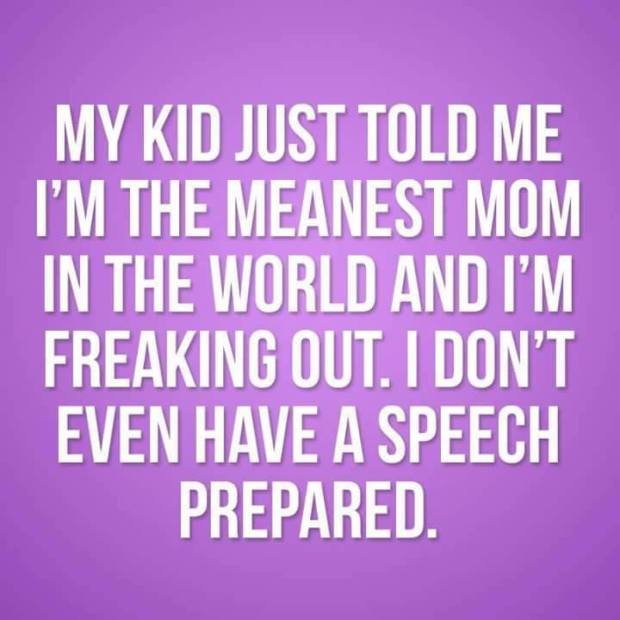
Being  a “pushy” mom or dad requires True Grit. Courage. Fortitude. A Backbone. When life gets hard, kids tend to give up. If we insist they stick with it, we are called “mean.”  Someone wrote, “My kids just told me I’m the meanest mom in the world and I’m freaking out. I don’t even have a speech prepared.” Parents! If your child hates you for something that is really, really good for them, take a bow, accept the nomination, and thank your audience. 

Parents raise successful kids by being pushy in these three ways:

Push Toward Good.

I once knew a parent who buckled under their 5 year old who refused to take his prescribed medicine. Some things are hard, some things don’t taste good, some things are boring (like brushing our teeth), and some things hurt (like getting immunized) but we insist our children do it anyway because it is good for them.  

My sister has taught voice and piano for 30 years and out of the hundreds of students, only two loved to practice. The rest think it’s hard and boring. Many kids dropped playing the piano after the first year. Those who became good were not prodigies or genius musicians; they had pushy parents who made them practice 5 days a week, year after year.

Recently, I helped my daughter register at a university. However, she became anxious and lacked confidence to navigate a new campus. As we sat with her adviser, fear took over. I realized I needed to not only reassure her, but to push.

Adviser: So what is your major?

Daughter: (shoulders slumped, eyes down) I don’t know.

Me: Integrated Studies.

Adviser: (wondering who is this pushy mom) So what will be your two areas of emphasis?

Daughter: I’m not sure.

Me: She declared Spanish and Business.

Adviser (looking directly at my daughter so I didn’t butt in) Will you start Summer of Fall?

Daughter: I don’t know.

Me: (pausing first before butting in) She’ll start Summer.

Adviser: (giving me the stink eye and then turning to my daughter) Do you have your transcript?

Daughter: Yes, but I don’t know how to download it.

I stayed out from that point on, but I’m telling you, we sometimes have to hold our kids hands and baby step them toward the unknown, scary future.  To that adviser: Don’t judge.

Push Away from Bad.

Children have a lot of choices these days and they’re not all good. Some may seem good  but turn into problems if there are not diligent parents afoot. It’s okay to tell your young child they don’t need a cell phone with Wifi or unlimited data. It’s okay to push away bad media programming that infiltrates our homes and electronic devices. A wave of filth is threatening families but we can push it away. Say “no” to children who tell you everyone else’s parents are letting them do it.

Tell them you love them more than that.

Push Back from Pressure.

Unlike many children, there are superstar kids who excel at everything and want to do it all. They overbook their lives, or their parents overbook it for them, to achieve greatness and an impressive resume. There is so much pressure to raise trophy children and compete with over-achieving friends.

Raising a great kid who is successful means they lead a balanced, happy, well adjusted life. Children need a childhood. They need play time, laugh time, creative and social time. If your child wants to be the drummer in a rock band, be on the high school basketball, swim, and baseball teams, be student body president, and sing in the prestigious school choir, it’s time to push back. Life is full of great things to do, but we need to teach our children that it’s not realistic or healthy to try to do it all. We all need to learn how to choose and prioritize.


So if you are a pushy parent, take it as a compliment. You know that you’re doing something right and you’re in good company.

Pregnancy Myth Busters

You’ve heard of the kid TV series “Myth Busters” right? One of those fun, educational shows where the group of geeks try out myths to see if they are real or not. Well, there are a lot of myths, legends, wives tales, whatever you want to call them, floating around about pregnancy. Everyone’s got advice and some crazy story about how to predict the gender.

It think it’s because pregnancy itself is so mysterious. What is really happening inside the womb and to the mother’s body? Is it a boy or a girl? Why am I so sick with this second pregnancy, but not the first? We all want answers!

Well I am speaking about which myths about pregnancy are true and which are not on BYU radio on the Matt Townsend show on Tues, April 19th. Here’s a sneak peak.  See how well you score and be sure to tell others what an expert you are now (not!)

Predicting gender: if you are carrying your baby high, it’s a girl. Carrying low? Stock up on blue. False.

Craving sweets? According to some, that means you’re going to have a little girl. Salty and sour cravings indicate a boy. False again. Predicting gender is never a trustworthy science, unless of course that involves an ultrasound.

You can’t get pregnant while nursing. False, mostly. Although nursing decreases the chance of ovulation, it doesn’t guarantee it. And there’s nothing more shocking than a new mother of a 5 month old who finds out she’s pregnant…again!

You shouldn’t have sex while pregnant because you might harm the baby.

False unless you have a specific medical condition and your doctor warns you against it.

You shouldn’t take hot baths while pregnant.

True, actually. You should avoid saunas, Jacuzzis or anything that raises your body temperature over 102 degrees. But you can take a bath in warm or slightly hot water. Some people even naively think that they can’t take a bath at all, that it will drown the baby! That’s another myth I’d like to bust right here.

You should abstain from alcohol during pregnancy.

True, although some studies have shown that up to 2 glasses of wine per day is not harmful. However, most doctors will tell new mothers to be on the safe side and abstain.

You will crave pickles and ice cream.

No. But cravings can occur, and are usually harmless. Husbands: be prepared for the Big Mac midnight runs. (At least mine had to on more than one occasion).

Cravings mean your baby “needs” that food. False. There are, however, some women who crave laundry detergent, paint chips, or clay. These odd cravings (called pica) have been associated with iron deficiency and you should talk to your doctor immediately if you experience them.

Gender predictor: if you mixes Drano with urine, it can determine the sex of your baby. The prediction is if you pour it down the toilet, and it turns blue, you have a boy; pink, it’s a girl. False. There’s another myth down the drain. I think this myth originated with the Drano Company to increase profits.

A fetus is sealed away in the uterus, unaffected by what’s going on outside. False. A baby can feel the stress from the environment and become distressed as well. It can detect sounds and emotions as well as ingest chemicals from tobacco and drug use.

Going to prenatal check ups is extremely important.

Yes, yes, and yes! Don’t skip this essential part of pregnancy. A doctor’s supervision might just be the key to your baby’s survival, health, and even your health. You’ll be checked for gestational diabetes, get a few ultrasounds to detect the development of the baby, and monitor any prescription drugs you are taking that might affect the fetus.

Your water always breaks when you go into labor and will gush like a faucet.

Nope. It doesn’t always break before and sometimes it’s just a trickle you don’t even notice.

The pregnant couple will sometimes feel disconnected and disoriented to one another.

True, and if not, it may happen shortly after becoming new parents.

Having wide, curvy hips make child birthing easier.

False.  It’s the size of the pelvis, not hips.

Drinking castor oil, eating spicy food or jumping on a trampoline will kick-start labor.

False. Sorry. The baby will come when it is good and ready.

Pregnant women should avoid exercise.

False. Sorry again. Exercise is actually very good for the baby and mom, but should be done moderately and with a doctor’s approval.

The second birth will be easier.

True, but not always. Still, it’s a nice thought when considering having more than one child.

You will feel an instant bond with your newborn baby.

False. New mothers and fathers may not naturally feel a euphoric sense of love and connection with their baby. Don’t worry if that is the case. Give it time. If post-partum sets in, see a doctor.

Couples should wait at least 6 weeks after childbirth to have sex.

True. Have fun.

6 ways parents can improve their listening skills

This was my first time being interviewed by someone from Utah Valley 360 magazine. It’s always cool when someone calls you up out of the blue, unexpected, and says they want to interview you for their upcoming article.

Well, here it is. And I think Natalie did a nice job with the article. Published on February 29, 2016

If you feel like your kids hardly listen to a word you say, take heart. Children and teens ignoring their parents is a universal problem as old as parenting itself. But before you put all the blame on your offspring, consider whether your listening skills could stand to be improved. Try these six tips for improving your listening ear:

  1. Stop multitasking and pay attention.

Our brain doesn’t have the capacity to fully attend to two things at once, so it’s difficult to listen well when doing another task that requires your attention. Doing the dishes and helping a child with homework? Sure. But scrolling Instagram while listening to your daughter explain her school project? It’s likely you’ll miss important details. “It’s really important that we select moments of the day where we close all those tabs we have open in our brain,” says Julie K. Nelson, an applied parenting instructor at UVU and author of two books on parenting, including “Keep it Real and Grab a Plunger: 25 tips for surviving parenthood” (Cedar Fort, March 2015). “We need to say to our child, ‘Right now, you are my world.’ Half listening will not build trust or confidence in coming to us when they need to talk.”

  1. Take it one kid at a time.

Do your best to listen to one child at a time. If interrupting and talking over each other is a problem at your house, Nelson suggests telling your kids that you are going to listen to all of them but only one at a time. “Put your arm around the child and say, ‘I’m here for you but right now we are going to listen to Stacey first and it will be your turn next,’” she suggests. Give them a physical cue, such as holding their hand or putting a hand on their shoulder, to let them know you see them but give your full attention to the child speaking. If a child whines or demands attention, ignore it as best you can. “When you are finished listening to one child, turn to the other child and say, ‘Thank you for being so respectful. Now it’s your turn.’”

  1. Listen on their level.

Adults appreciate eye contact during an conversation, and kids are no different. Nelson suggest talking to kids at their level for the most effective communication. “If we do want to get a child to listen to us, it’s so important there is not an imbalance of power. At your full stature, children don’t listen to you when they are looking at your navel.” Younger kids appreciate when you get down on one knee to hear and see what they are saying. For teens, try sitting on a couch to chat.

  1. Go on sabbatical from offering your opinion.

If it’s a challenge to keep your mouth shut when you should be listening to your child or teen, try this challenge: For one week, resist the urge to offer your opinion unless expressly asked for it. Listening with the intent to simply listen, instead of listening with the intent to reply, Nelson says. “When we do listen to someone we should be very careful that we don’t try to finish their sentence for them or come up with a rebuttal or response,” Nelson says. If they do ask for an opinion, let them know you’ll think about it rather than jumping in with your expert advice.

  1. Practice active listening.

If you need to clarify what someone is saying, repeat what you heard back to them. Try, “What I’m hearing you saying is this; is that correct?” Let the speaker validate whether or not you got it right. Then continue listening without judgment or fixing. Most of the time, people just want to be heard.

  1. Quit topping the story.

If your child is complaining about their struggles at school, it can be tempting to hijack the conversation with stories of your childhood success or examples of what other siblings have done. They don’t really need to hear about everything you did when you were a kid, Nelson says — even if you’re commiserating —  they just want to you listen to them. So stop topping their stories and simply offer yourself as a resource. “Tell them, ‘I’m sure you’ll come up with a great solution to that.’ Empower them … let them come up with solutions on their own. They need to know you’re not the higher power in their life that always sweeps in and solves things,” she says.

For a link to the origional article in Utah Valley 360 magazine: http://utahvalley360.com/2016/02/29/6-ways-parents-can-improve-their-listening-skills/